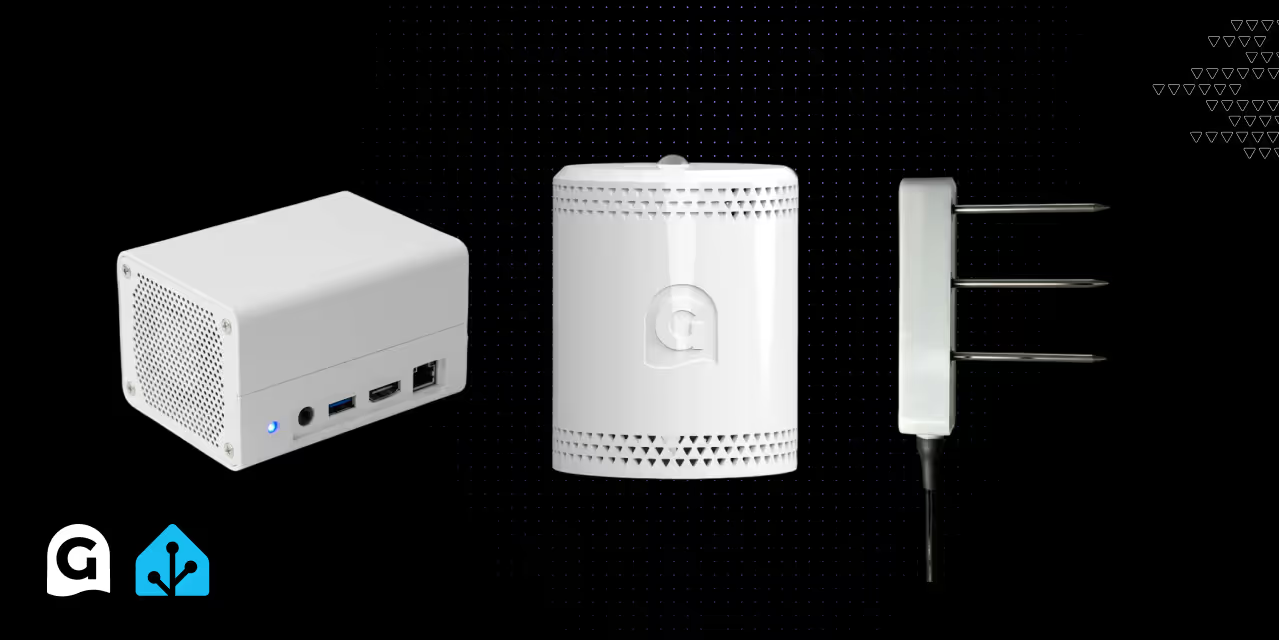
If you have been considering using a grow room Home Assistant set up in your grow space, you are likely in one of two camps.
Either you are already running Home Assistant and want to integrate your growing environment properly, or you are tired of overpriced, closed grow controllers and want something flexible, local, and under your control.
Home Assistant is perfect for that. The missing piece has always been good data.
That is exactly where Grow Sensor PRO fits in.
It is built for serious growers who want to use Home Assistant for growing plants without spending evenings building sensors from scratch.
You plug it in, point it at Home Assistant, and you suddenly have the kind of real time data you normally only see in lab-grade setups: leaf temperature, leaf VPD, CO₂, PPFD, DLI, substrate EC and more.
Accurate, calibrated, and ready to automate your next harvest.
Disclaimer: Any information given on this site is for educational purposes only. Please ensure if you’re growing indoors, you’re doing so in accordance with the law and subject to appropriate permissions and licenses of the applicable country.
What Home Assistant actually is
Home Assistant is an open-source automation platform that runs locally on a Home Assistant server, or small computer like a Raspberry Pi, or even in a container.
In normal smart-home terms, people use it to connect their lights, plugs, thermostats, cameras and speakers and then build automations on top.
In a grow room, that translates to something much more interesting.
With a good sensor and a few controllable devices, Home Assistant can become the brain of your whole environment - a DIY grow room controller.
Home Assistant can automate grow rooms by flipping your grow lights on and off for veg and flower, dimming them if things get too hot, spinning the exhaust fan up and down, running heaters and dehumidifiers, and managing CO₂, all from one dashboard.
The point is not that home automation via Home Assistant is flashy.
The point is that it is open, it is local, and it gives you logic and visibility of other stuff that most smart grow controllers simply do not.
Why Home Assistant makes sense for indoor growing
Common plants grown indoors can be unforgiving when it comes to environmental requirements.
You can get away with “good enough” if you are just happy to pull a harvest, but if you want top shelf and repeatable results, you have to dial in the details.
Things like VPD (vapour pressure deficit), humidity, temperature and CO₂ are obvious.
Once you dig a bit deeper, you realise that leaf temperature and leaf VPD are even more important than room VPD, that PPFD and DLI tell you far more about your lighting than a simple wattage number, and that substrate moisture (VWC) and EC are essential for modern crop steering.
Home Assistant is perfect for this because it does not care what you connect to it.
If your lights, fans, heaters, CO₂ regulators, or pumps can be switched, dimmed, or controlled via a smart plug, relay, or integration, Home Assistant can orchestrate them.
It can ramp fan speed based on leaf VPD, dim an LED light when your canopy gets too hot, or send you a notification when your substrate gets too dry.
The catch is simple: the automations are only as good as the data you feed in.
This is the significant weakness of most grow room Home Assistant setups you see online.
People wire together a few cheap sensors, or buy devices with ±5% humidity accuracy, no calibration and poor drift control, and then wonder why their automations feel random.
That is the gap Grow Sensor PRO was designed to fill.
Grow Sensor PRO: Built with Home Assistant growers
Over the last five years, we have been working directly with Home Assistant growers to build a sensor that actually does what they need.
Not a toy. Not a locked-down beginner device.
A compact, calibrated, robust sensor that measures everything a modern, tech-savvy grower wants and plugs into Home Assistant in about five minutes.
We are growers ourselves, so the thinking has always been to build something we would actually trust in our own rooms.
Quality, usability and calibration sit at the top of the list.
Most sensor/control system products on the market take the opposite approach: they are closed, poorly made, limited in what they measure, and often designed more for marketing than plant physiology.
Making your own gear from scratch is fun. A lot of us have done that for years. But at some point, you want a device that just works.
You want to unpack it, hang it, connect it, and start using the data without wondering if the numbers are lying to you.
When you get a Grow Sensor PRO, that is what you get.
A member of our team fully calibrates the sensor before it leaves.
We support you through Home Assistant integration if you need a hand. And we actively listen to HA growers using the device to shape where the product goes next.
What the Grow Sensor PRO measures (and why it’s important)
The Grow Sensor PRO covers all the basic environmental metrics you would expect: temperature and humidity, VPD, CO₂ and pressure.
This alone would be enough to drive a decent DIY grow room Home Assistant setup, but the real value is in the extra layers.
On the canopy side, it measures leaf temperature with a dedicated IR sensor and then calculates leaf VPD and the difference between air and leaf temperature.
That gives you a much closer picture of what the plant is experiencing, rather than just what the room air is doing.
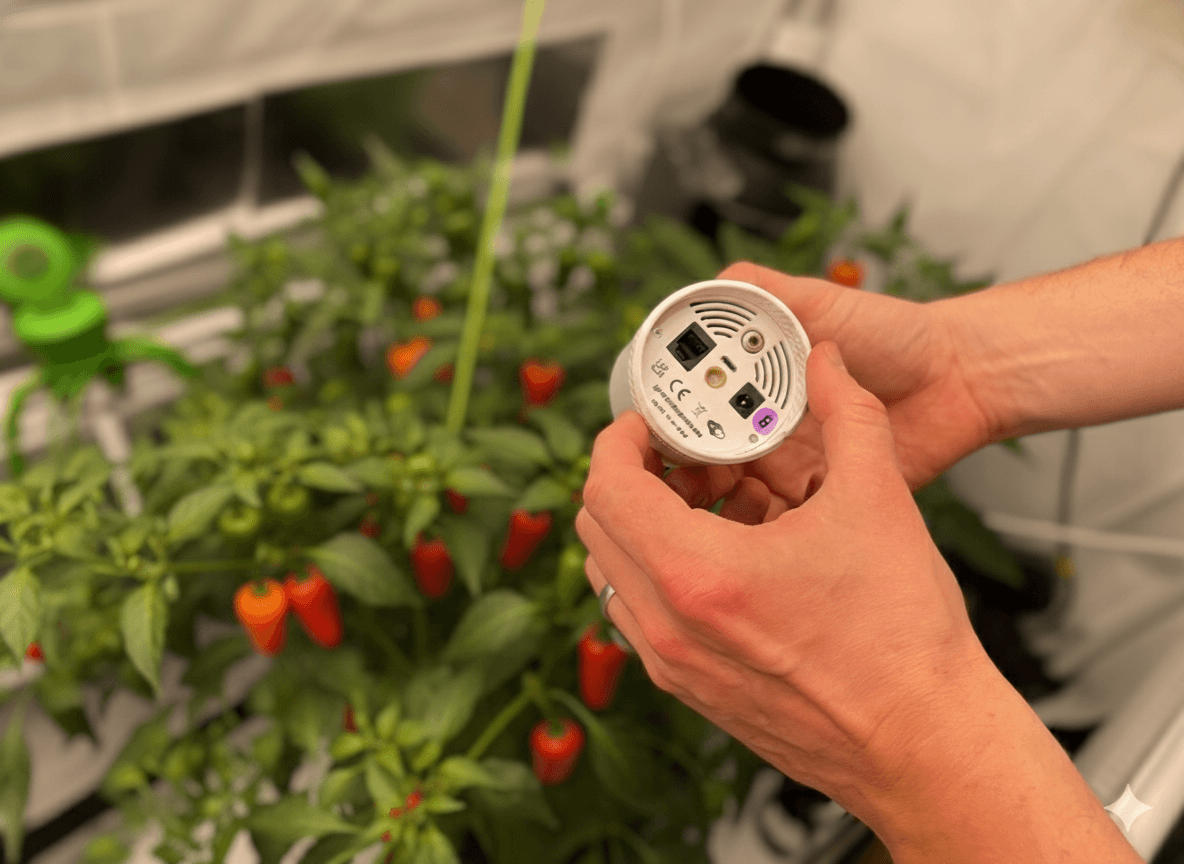
On the lighting side, it uses an extended-spectrum ePAR sensor covering 400–750 nm.
It measures PPFD and DLI, and breaks the light into blue, green, red, and near-infrared bands.
That means you can stop guessing and start actually knowing how much light hit your crop in the last 24 hours.