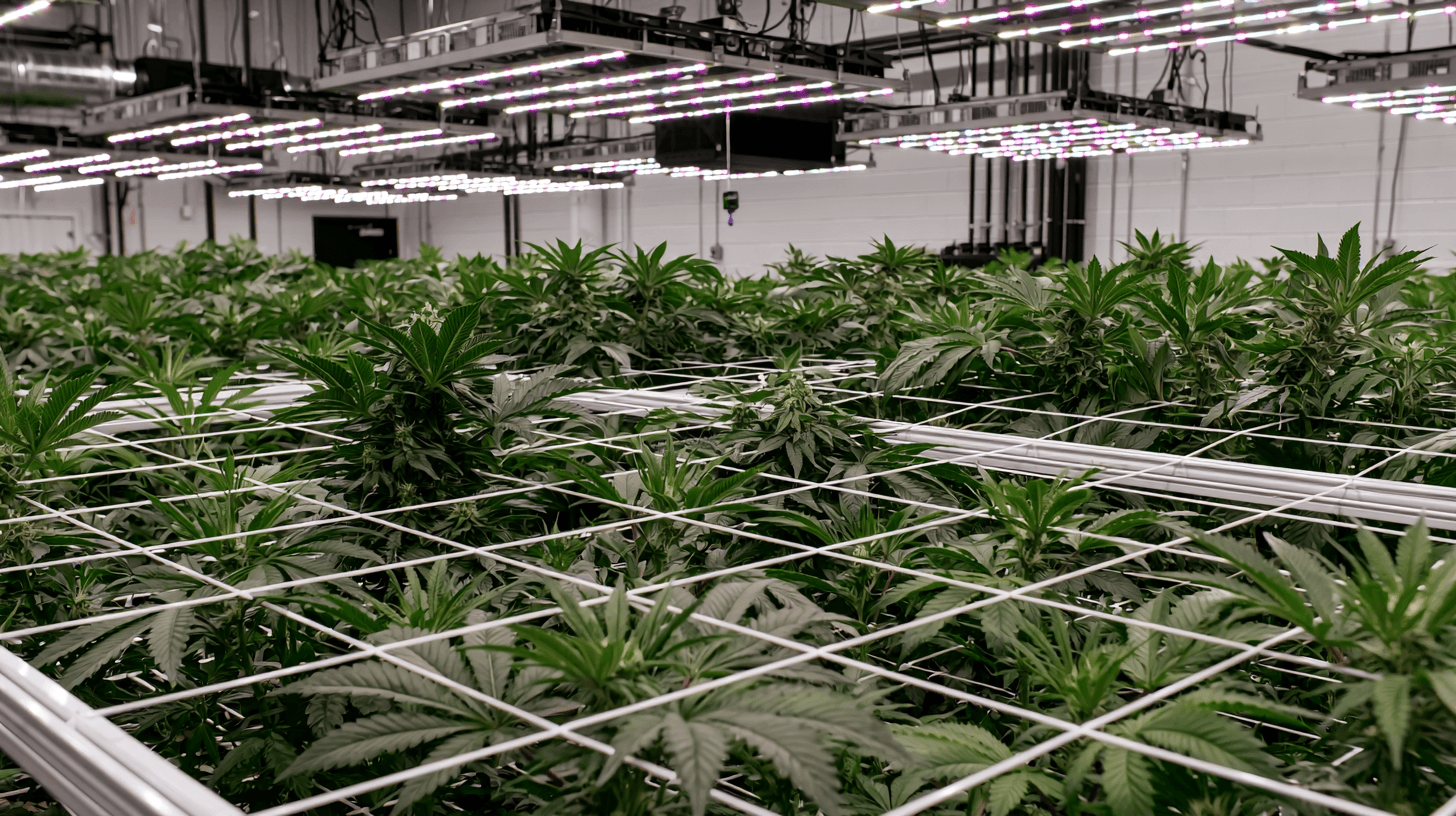
LED growers are told to run the room hot. The lamps give off far less radiant heat than HPS, so the advice is to turn the air up to make up for it, sometimes past 30 °C once CO₂ goes in.
The research supports a warmer LED room, by a degree or two. Getting LED grow room temperature right also means knowing what too much heat does to flower: when Wageningen University flowered cannabis at 31 °C under LEDs with CO₂, cannabinoids fell.
Below are the day and night targets we use for every stage, with and without CO₂, and the study behind each one. They're air temperatures at the canopy: a starting point to tune for each cultivar.
Why LED rooms run warmer, and by how much
HPS lamps throw a lot of infrared. It heats the leaf directly, so a leaf under HPS can sit above the air around it. LEDs put out much less, so in the same air the leaf runs a little cooler.
How much cooler was the question Jacob Nelson and Bruce Bugbee set out to answer at Utah State University. They measured the light reaching leaves under sunlight, HPS and LEDs, and modelled leaf temperature at the same light level. Under typical indoor conditions, LEDs lowered leaf temperature by about 1.3 °C compared with HPS. Leaves that weren't short of water stayed within 2 °C of the air under every light source. In their words, "the effect of LED technology on leaf temperature is smaller than is often assumed" (Nelson and Bugbee, PLOS ONE, 2015).
So a room moving from HPS to LED needs a degree or two more air to give the leaf what it had before. That's a long way from a 30 °C room.
The gap also moves through the day. A leaf that transpires freely cools itself; a stressed leaf closes its stomata and warms up. That's why the targets below are air, and why the leaf is worth checking as well. Our post on leaf surface temperature under LEDs goes deeper.
LED grow room temperature, stage by stage
Our targets, stage by stage
Air at the canopy, °C. Each line runs through the middle of its range. CO₂ comes out for ripening, and the dry room has one setting.
- Day
- Day, with CO₂
- Night
- Clones
- Day: 24–26
- Day, with CO₂: 24–26
- Night: 22–24
- Veg
- Day: 25–27
- Day, with CO₂: 27–29
- Night: 20–23
- Stretch
- Day: 24–27
- Day, with CO₂: 26–29
- Night: 19–22
- Bulk
- Day: 22–25
- Day, with CO₂: 24–27
- Night: 18–21
- Ripening
- Day: 21–24
- Day, with CO₂: 21–24
- Night: 16–19
- Drying
- Day: 18–20
Grow Sensor targets for LED rooms, set from the studies in this post.
| Stage | Day | Day, with CO₂ | CO₂ | Night |
|---|---|---|---|---|
| Seedlings and clones | 24–26 °C | 24–26 °C | none | 22–24 °C |
| Veg | 25–27 °C | 27–29 °C | 800–1,000 ppm | 20–23 °C |
| Stretch, flower weeks 1–3 | 24–27 °C | 26–29 °C | 1,000–1,200 ppm | 19–22 °C |
| Bulk, weeks 4–6 | 22–25 °C | 24–27 °C | 1,100–1,400 ppm | 18–21 °C |
| Ripening, last 2 weeks | 21–24 °C | 21–24 °C | back to ambient | 16–19 °C |
| Drying | 20 °C for 3 days, then 18 °C |
We don't enrich clones and seedlings. Their light is low, and CO₂ pays back with light. From veg on, the CO₂ column runs about 2 °C warmer than the day column. Flower days come down as the run goes on, and nights sit 4 to 6 °C under the day.
CO₂ lets the day run warmer
Above its best temperature, a leaf loses more and more of the carbon it fixes to photorespiration, a side reaction that speeds up as the leaf warms. Extra CO₂ crowds it out, so CO₂ and warmth work together and the best temperature for photosynthesis moves up. A review in Global Change Biology this August, looking back over decades of work, puts it plainly: "elevated CO2 and higher temperature can act synergistically to raise the thermal optimum of photosynthesis" (Bernacchi and Cavanagh, 2026). The same review is careful to add that real canopies often fall short of the theory.
For cannabis itself, the best-known numbers come from the University of Mississippi. At ordinary CO₂ and high light, photosynthesis peaked between 25 and 30 °C in most of the varieties they tested, and at 30–35 °C in one (Chandra et al., 2011). Raising CO₂ to 750 ppm lifted net photosynthesis by about 50% and water use efficiency by about 111% (Chandra et al., 2008).
That's the case for a warmer CO₂ room. The next study is the reason ours stops at 2 °C. For how much CO₂ to run and when, see CO₂ in the flowering stage.
Too hot in flower costs cannabinoids
Wageningen University ran a test that looks a lot like a modern LED facility. Two medical cultivars, 'Original Blitz' (THC) and 'Harmony CBD', flowered under LEDs at 600, 900 or 1,200 µmol/m²/s, with CO₂ at 1,000 ppm through the day. Half the runs flowered at 25 °C days and 21 °C nights, half at 31/27 °C (Holweg et al., Environmental and Experimental Botany, 2025).
Heat greatly reduced total cannabinoid concentration in both cultivars. 'Harmony CBD' also lost about 30% of its flower dry mass, and fox-tailed. The authors describe it directly: "High temperatures caused abnormal inflorescence clusters to develop on top of older inflorescences, disrupting typical maturation and leading to lower cannabinoid levels." 'Original Blitz' kept its weight and still lost cannabinoids. Terpenoids didn't change.
One caveat from the authors: an irrigation fault hit one of the hot runs early on, which weakened some of the statistics for 'Harmony CBD'.
Light was the better lever. More light raised flower dry matter in a straight line without changing the chemistry. So push yield with light and CO₂, and keep the heat in check. Our stretch targets reach 29 °C with CO₂ for three weeks; from bulk on, they stay at 27 °C or below.
Nights: 4 to 6 °C below the day
Night temperature changes how the plant spends what it made in the day. At Chungnam National University in South Korea, hemp clones flowered under five day/night splits, from 18 °C days with 30 °C nights to the reverse. Flower weight was highest at an even 24/24 °C and 4.7 times lower at 18/30. Cannabinoids in the flowers were highest at 27 °C days and 21 °C nights, and the authors named that 6 °C drop the best setting (Bok et al., Agronomy, 2023).
It was hemp, in a small space, so read it as a direction. Our nights sit close to that split.
Cold finishes come with their own lore. Cool nights can bring out purple, and a University of Wisconsin–Madison study found anthocyanin, the purple pigment, peaked at cool temperatures. In the same plants, CBD and flower weight tracked maturity instead (Kim et al., Journal of Cannabis Research, 2025). Purple is colour, not potency.
Late flower and the dry room
In the last two weeks we bring days down to 21–24 °C and nights to 16–19 °C, and take the CO₂ back to ambient. The Wageningen results are the main reason: the hot rooms lost cannabinoids and fox-tailed as the flowers matured.
Terpenes are a different story. Heat in the flower room didn't change terpenoids in that trial. Most terpene loss happens after the chop, in drying and storage, which our post on growing environment and terpenes goes through.
For the dry room we hold 20 °C and 55% humidity for the first three days, then drop to 18 °C. There's more on the dry and cure in how the best growers dry and cure.
Set them as limits, and check the leaf
Measure at the canopy. A wall sensor can read differently from the top of the plants, and the canopy is what the targets are for. Where to measure temperature in a grow room covers placement.
Then check the leaf as well as the air, because that's the temperature the plant works at. Grow Sensor PRO reads leaf temperature with an infrared sensor, and a GrowOps recipe holds day and night limits for each phase, so a room that drifts outside them shows on its chart.
Part 2 of the LED recipe covers humidity and VPD, stage by stage.