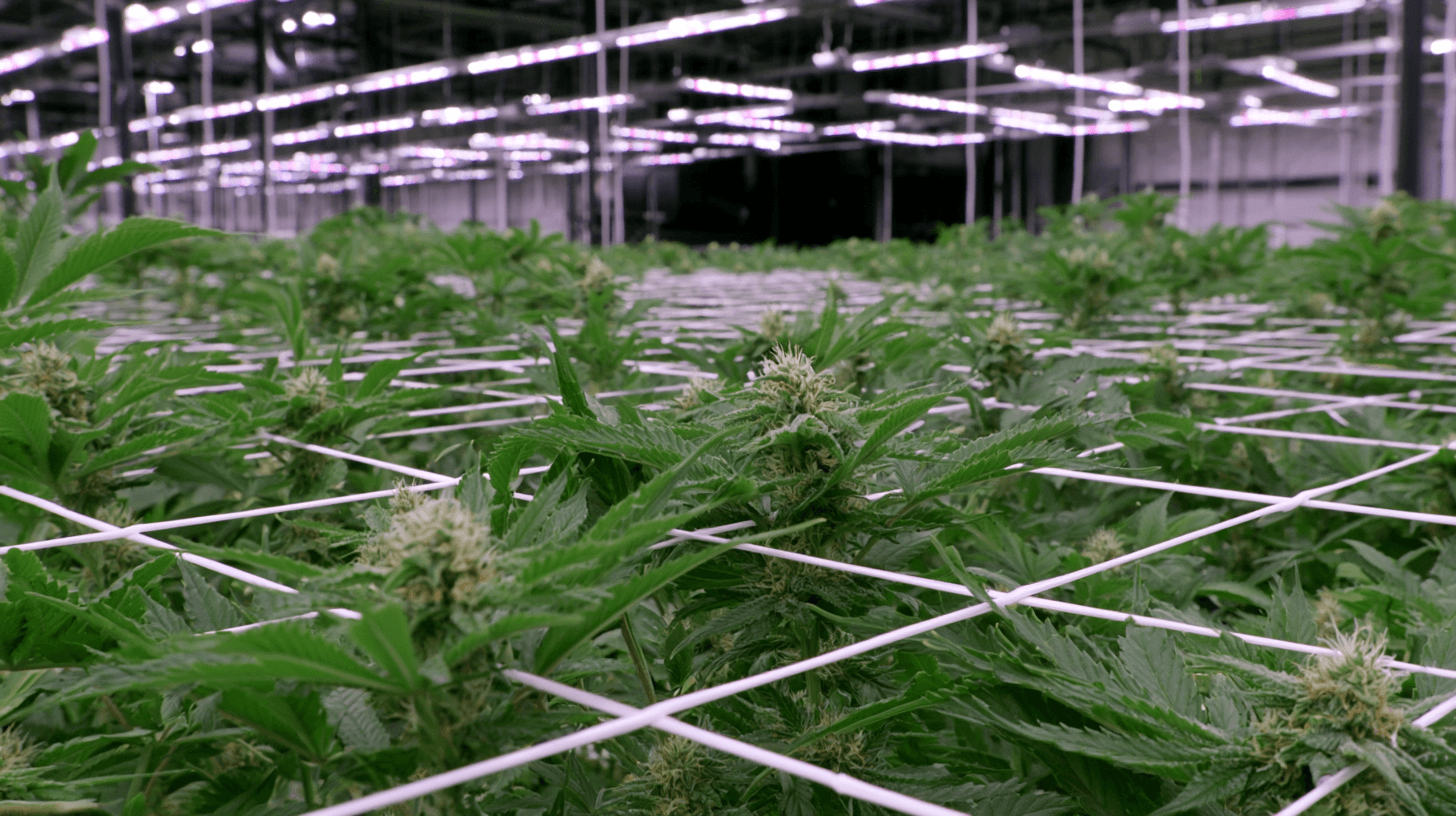
Most flower rooms feed to a recipe. The EC target is set for the week, the tank is mixed to it, and the plants get the same solution whether they're drinking hard or slowing down.
A Colorado State University study published in October measured what that misses. Cannabis nutrient uptake rose after the flip, peaked about three weeks into flower and then fell, in step with how much water the plants moved. By late flower, nitrogen and potassium were coming out of the root zone stronger than the feed going in.
A recipe assumes the plant takes the same every week
EC is one number for every ion in the tank. It measures strength, and says nothing about what the plant is taking out. Kit Powell and William Bauerle at Colorado State argue that feeding to fixed setpoints invites excess or unbalanced feeding, and that a crop worth as much as cannabis is especially prone to it (Powell and Bauerle, Frontiers in Plant Science, 2026).
Their alternative is a mass balance. Transpiration, the water movement that VPD drives, pulls water through the plant and carries dissolved ions with it. So you measure the water the plant used and what it removed from the solution, and replace that, instead of holding the tank at a set strength.
The same lab tested the idea in veg earlier this year. Measured per litre of water the plants transpired, nitrogen and potassium uptake peaked in the first week and had dropped by the second (Powell and Bauerle, 2026, vegetative phase). The new paper takes the same method through 60 days of flower.
How they measured it
Two cultivars, CJ2 and First Light, were rooted in rockwool cubes, set into 11-litre Bato buckets of perlite and drip-fed through two stakes per plant in a greenhouse bay with a 26.5 °C set point. Perlite holds very little on its exchange sites, so a change in the drain mostly reflects the plant. Flower started on 10 September 2024.
Eight plants of each cultivar sat on balances logging their weight every 10 minutes, so the water each plant transpired was weighed directly. Every tenth day the team took a pour-through sample of the root-zone solution and harvested three plants per cultivar, split into roots, stems, leaves and flowers for tissue analysis.
Know one thing before reading the numbers. The feed was deliberately rich, at 250 mg/L nitrate nitrogen, 350 mg/L potassium and 60 mg/L phosphorus, so the plants never ran short and removal could be measured. Nobody would run it as a production recipe, and the study didn't compare feed levels against yield or grade. The paper also doesn't say whether the two cultivars are hemp or high-THC types.
Cannabis nutrient uptake in late flower: a peak at day 20, then a fall
In both cultivars, net removal, the feed's concentration minus the drain's, climbed from the flip to a peak around day 20 and fell from there. After day 50, nitrogen and potassium were building up in the root zone above the strength of the feed.
| Element | Cultivar | Peak removal (mg/L) | Late flower (mg/L) |
|---|---|---|---|
| Nitrogen | First Light | 130 | 109 above the feed |
| Nitrogen | CJ2 | 90 | 101 above the feed |
| Potassium | First Light | 192 | 195 above the feed |
| Potassium | CJ2 | 102 | 195 above the feed |
| Phosphorus | First Light | 58 | 13 still removed |
| Phosphorus | CJ2 | 42 | 2 above the feed |
Net removal is the feed's concentration minus the drain's. Source: Powell and Bauerle, 2026.
Water use efficiency moved with uptake. CJ2 made 4.50 g of dry biomass per litre transpired at its peak on day 30, and First Light levelled off at about 3.4 g/L across days 20 and 30.
The cultivars weren't identical. First Light took up more early on, CJ2 used its water more efficiently, and cultivar had a significant effect on phosphorus, potassium, calcium and iron. The authors call the differences marginal, but enough to suggest the top-up may need setting per cultivar.
Their conclusion is short: "fertigation should at least respond to observed solution drawdown rather than maintain fixed input targets" (Powell and Bauerle, 2026).
How well water use predicted the top-up, and the weeks it skipped
The team predicted each top-up from the nutrients held in the plant's tissue, weighted by how much of the plant each organ made up and scaled by water use. For CJ2, the best version, which left the flowers out, came within about 7% of measured nitrogen removal and within 6% for magnesium. First Light was looser. Its best magnesium estimate was 25% out. The most accurate predictor also changed as flower went on, and no single organ stayed the best guide.
The bigger limit is timing. Days 50 and 60 were left out of the accuracy test, because nutrients building up in the substrate broke the steady state the balance relies on. So the model was only checked up to mid-flower. The late weeks, where overfeeding happens, went untested.
The authors are open about the rest. The framework overestimated the top-up in late flower, and some of what left the solution may have stayed in the perlite, precipitated or been tied up by microbes instead of entering the plant. It ran in one greenhouse, in a substrate chosen for holding almost nothing. Coir holds far more, so in a coir room the substrate's share of the balance would be bigger again.
One leaf test can point the wrong way
As flower went on, leaf calcium and magnesium rose while leaf nitrogen fell. Read alone, that leaf says feed more calcium and magnesium. But leaf tissue consistently overestimated what the whole plant needed topped up for both, and the authors put the rising leaf magnesium down to the plant moving it out of its stems and roots, not taking more from the feed.
A leaf test is a reading, not a feed instruction. Set it beside the drain numbers before changing the recipe.
Earlier trials: a stronger feed in flower didn't buy yield
The Colorado paper shows uptake falling. It doesn't show that cutting the late feed protects yield or grade. The closest evidence for that comes from trials that fed flower at different strengths:
| Trial | Cultivar and system | What changed | Result |
|---|---|---|---|
| Utah State, 2022 | High-CBD 'T1', soilless pots | Phosphorus at 25, 50 or 75 mg/L | No gain in yield or cannabinoids; phosphorus in the leachate rose about 12-fold |
| Guelph, 2021 | High-THC 'Gelato', deep-water culture | N 70–290, P 20–100 and K 60–340 mg/L through flower | Yield peaked near 194 mg/L N and 59 mg/L P; potassium had no effect; cannabinoids unchanged |
| Hohenheim, 2023 | CBD-rich type, substrate pots | Nitrogen at 80, 160 or 240 mg/L | 160 gave about 95% of the CBD yield of 240 (the gap wasn't significant) on a third less fertiliser |
| Utah State, 2025 | High-CBD 'T1', hydroponics | Phosphorus 15–90 mg/L at EC 2 or 4 mS/cm | No effect on yield or cannabinoids; EC 2 mS/cm and 15 mg/L phosphorus were enough |
Bruce Bugbee's lab at Utah State put it plainly: "neither excessive P nor excessive fertilization improves yield or quality" (Hershkowitz, Westmoreland and Bugbee, 2025).
Two cautions. Guelph's is the only high-THC trial in the set, and it found a real optimum for nitrogen and phosphorus, with yield falling away on either side, so less isn't automatically better. And none of these trials cut the feed only in the late weeks, which is the question the Colorado data raises.
They do line up on potassium. The Colorado feed carried 350 mg/L. Guelph found no yield response anywhere between 60 and 340.
What this means for your feed SOP
A flower room has three ways to set the late feed:
- Hold the recipe and EC target to the chop. Simple to run, and the Colorado data says it overshoots in the late weeks.
- Taper by calendar, from a supplier's chart. It moves the right way, but the size and timing come from someone else's rooms.
- Set it from what your room is drawing down. That's where the paper's conclusion points, and it runs on records most rooms don't keep yet.
Those records, per room and per cultivar, by day of flower:
- feed volume and drain volume
- EC and pH of the feed and of the run off
- an ion-specific lab test of feed and drain every couple of weeks, so you know which element is behind a rising EC
- the date of every change to the recipe
In the paper's terms, net removal is the benchmark: feed above it is unlikely to improve nutrition, and ends up in the slab or the drain. Our reading, which the paper didn't test: when water use per plant starts falling in late flower, check the drain chemistry before topping up at the usual strength.
Rooms that crop steer on dry-back and substrate EC already log part of this at the root zone. Between lab tests, the slab gives an early hint. Grow Sensor's SubSense probe logs substrate water content and EC, so a slab EC that keeps climbing late in flower shows up before the next drain result comes back.
Feed the plant doesn't take is paid for twice, once in the tank and again in handling the runoff. The authors point to Ontario's rules on greenhouse nutrient feedwater as a sign that measured nutrient use is where regulation is heading.
Before you change the SOP across the site, trial it. Run one room against a control room of the same cultivar, change only the late-flower feed, and judge it on grade and drain EC over at least two runs. That design is ours. Two runs of your own will tell you more than any chart.